主播
大家好,欢迎收听 Full of Mind 播客,我是主播小果汁。
在社交网络上,我们经常看到这样的集体自嘲:「白天是个情绪稳定的成年人,晚上躺在被窝里开始自我审判」;「把情绪价值留给工位,把精神内耗留给自己」。
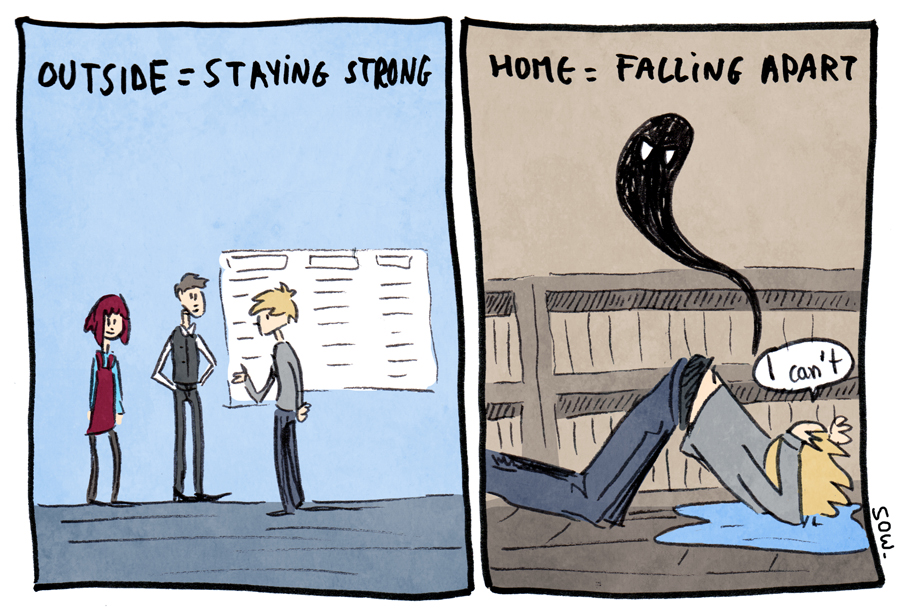
这种被社会美德与道德自豪感层层包装的内耗,我们称之为「隐性内耗」。 它最危险的地方,在于它的高度自洽: 你甚至会为自己能咽下委屈、能带病硬撑感到一种悲壮。所以哪怕身体已经开始用失眠、头痛消极罢工,理智依然觉得抽向自己的每一记鞭子,都正义凛然。
这期节目,我想跟大家聊聊这种被社会掌声包裹的隐性内耗,它和普通内耗有什么区别?脑海里那个苛刻的法官究竟从何而来?当身体已经开始用症状消极罢工时,我们又该从哪里,给自己松一松绑?
愿听完这期节目的你,在今晚能卸下白天的盔甲,安稳地睡个好觉。
[00:09] 引言,什么是隐性内耗?
[04:48] 越无力,为什么越会苛责自己?
[09:15] 那份未曾言明的童年契约
[14:36] 为什么成功的人反而更容易内耗?
[19:25] 脑海里那个严苛的声音
[24:55] 身体在抗议,为什么我们依然很难求助?
[30:31] 从哪儿开始松绑?
[38:24] 尾声
相关理论
- 罗纳德·费尔贝恩(Ronald Fairbairn):客体关系理论,「全能控制感」与道德防御
- 唐纳德·温尼科特(Donald Winnicott):真自体(True Self)与假自体(False Self)、徒劳感(Futility)
- 保罗·休伊特 & 戈登·弗莱特(Hewitt & Flett):社会认同的完美主义(Socially Prescribed Perfectionism)
- 克兰斯 & 艾姆斯(Clance & Imes):冒名顶替综合征(Impostor Phenomenon)
- 卡伦·霍妮(Karen Horney):应该之暴政(The Tyranny of the Should)与神经症骄傲
- 保罗·吉尔伯特(Paul Gilbert):情绪调节三系统模型(威胁、驱动、舒缓)
- 托马斯·博尔科韦茨(Thomas Borkovec):担忧回避理论(Avoidance Theory of Worry)
- 迈克尔·因兹利希特(Michael Inzlicht):疲惫与动机重心转移假说(Have-to to Want-to)
- 弗朗茨·亚历山大(Franz Alexander):矫正性情绪体验(Corrective Emotional Experience)
参考资料
- Fairbairn, W. R. D. (1943). The repression and the return of bad objects (with special reference to the 'war neuroses'). British Journal of Medical Psychology, 19(3–4), 327–341.
- Fairbairn, W. R. D. (1952). Psychoanalytic Studies of the Personality. London: Tavistock Publications.
- Winnicott, D. W. (1960). Ego distortion in terms of true and false self. In The Maturational Processes and the Facilitating Environment (1965, pp. 140–152). London: Hogarth Press.
- Bradshaw, E. L., Duineveld, J. J., Conigrave, J. H., Stewart, B. A., Ferber, K., Joussemet, M., Parker, P. D., & Ryan, R. M. (2024). Disentangling autonomy-supportive and psychologically controlling parenting: A meta-analysis of self-determination theory's dual process model across cultures. American Psychologist.
- Hewitt, P. L., & Flett, G. L. (1991). Perfectionism in the self and social contexts: Conceptualization, assessment, and association with psychopathology. Journal of Personality and Social Psychology, 60(3), 456–470.
- Curran, T., & Hill, A. P. (2019). Perfectionism is increasing over time: A meta-analysis of birth cohort differences from 1989 to 2016. Psychological Bulletin, 145(4), 410–429.
- Clance, P. R., & Imes, S. A. (1978). The imposter phenomenon in high achieving women: Dynamics and therapeutic intervention. Psychotherapy: Theory, Research & Practice, 15(3), 241–247.
- Horney, K. (1950). Neurosis and Human Growth: The Struggle Toward Self-Realization. New York: W. W. Norton & Company.
- Gilbert, P. (2009). The Compassionate Mind: A New Approach to Life's Challenges. London: Constable.
- Gilbert, P., Clarke, M., Hempel, S., Miles, J. N. V., & Irons, C. (2004). Criticizing and reassuring oneself: An exploration of forms, styles and reasons in female students. British Journal of Clinical Psychology, 43(1), 31–50.
- Borkovec, T. D., Alcaine, O. M., & Behar, E. (2004). Avoidance theory of worry and generalized anxiety disorder. In R. G. Heimberg, C. L. Turk, & D. S. Mennin (Eds.), Generalized Anxiety Disorder: Advances in Research and Practice (pp. 77–108). New York: Guilford Press.
- McEwen, B. S. (1998). Protective and damaging effects of stress mediators: Allostatic load. New England Journal of Medicine, 338(3), 171–179.
- Inzlicht, M., & Schmeichel, B. J. (2012). What is ego depletion? Toward a mechanistic revision of the resource model of self-control. Perspectives on Psychological Science, 7(5), 450–463.
- Alexander, F., & French, T. M. (1946). Psychoanalytic Therapy: Principles and Application. New York: Ronald Press.

 Full of Mind